

Your shopping cart is empty!
Dill "Gribovsky"
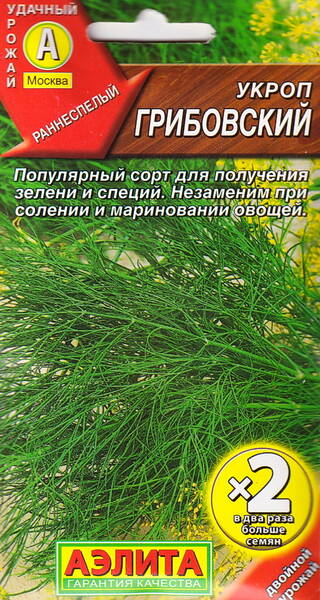
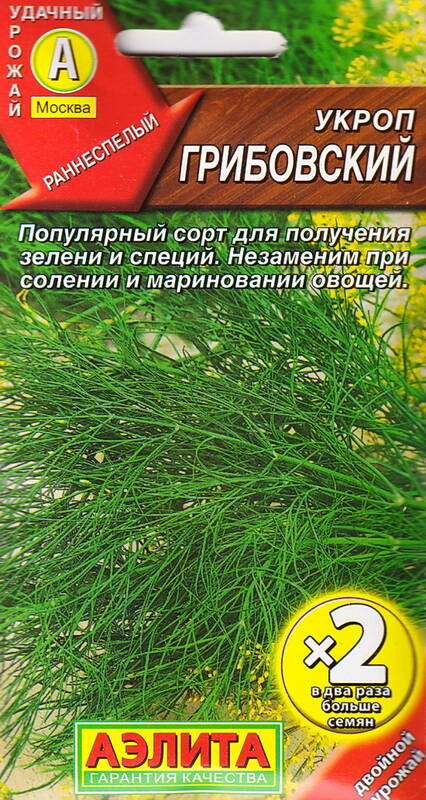
Dill Gribovsky.
Aromatic and unpretentious: indispensable for seasonings and pickles!
Medium-early variety. Rosette semi-spreading, with 4-5 large leaves, 14-25 cm high, leaves green with a slight waxy bloom. Seed bush 80-90 cm high.
Plants quickly move to flowering and the formation of umbrellas. The variety is productive, taste and aroma are high, relatively resistant to diseases.
Dill is a cold-resistant, light-loving and moisture-loving crop.
SOWING is carried out repeatedly - before winter with dry seeds and several times in spring, starting from the end of April - beginning of May, to a depth of 1-2 cm in a continuous or row method (with row spacing of 15-20 cm).
To obtain flowering plants, leave a distance of 45-50 cm between rows.
To speed up germination, it is advisable to soak the seeds before sowing for two days, periodically changing the water.
* Dill is demanding on soil fertility and moisture, especially at first (before emergence and 2-3 weeks after that). Therefore, when sowing, it is better to first spill the grooves with water and only then sow the seeds. This will allow you to quickly get friendly shoots. In the future, a lack of moisture does not destroy dill plants - they tolerate it, but very quickly move to flowering, and form several small umbrellas... However, dill does not tolerate stagnant water well either.
Features of his character:
- dill is a fairly cold-resistant plant - seeds begin to germinate at a temperature of +2+3°C.
- dill is a very light-loving plant, so it should only be placed in well-lit areas.
- dill is a long-day plant: dill moves to flowering when the daylight hours exceed 13 hours. With short daylight hours (10-12 hours), plants remain at the rosette stage and do not begin to bloom. With less daylight hours, the plants simply die - they do not have enough light to synthesize plastic substances.
Usually, dill begins to be used for food when the plants have formed a small rosette of leaves. The largest amount of essential oil and vitamins dill plants contain before the start of flowering of the central umbrella - it is during this period that it is recommended to harvest its greens for sale on the market, harvesting for the winter (drying, pickling, freezing) and for use as medicinal raw materials. During this period, the stems are still tender and can also be used for food.
In order to regularly have fragrant greens rich in vitamins and essential oil on the table, dill is sown in several terms, from May to August. From the appearance of seedlings to the onset of technical (harvesting) maturity of dill, it usually takes 40-60 days.
A feature of dill cultivation for greens is that these plants need to be watered and fed often. The dose of nitrogen fertilizers applied before sowing is increased.
A feature of dill cultivation for seeds is that nitrogen fertilizers are excluded from fertilizing after flowering, and watering is slightly reduced after the start of seed formation.
These simple techniques contribute to the increased accumulation of essential oil in the seeds. Seeds used as a spice begin to be harvested as soon as part of them (about 10%) turns slightly brown. And the mass harvesting of dill seeds (for future sowing) is carried out when up to 30-40% of them turn brown in the umbrella.
Aromatic and unpretentious: indispensable for seasonings and pickles!
Medium-early variety. Rosette semi-spreading, with 4-5 large leaves, 14-25 cm high, leaves green with a slight waxy bloom. Seed bush 80-90 cm high.
Plants quickly move to flowering and the formation of umbrellas. The variety is productive, taste and aroma are high, relatively resistant to diseases.
Dill is a cold-resistant, light-loving and moisture-loving crop.
SOWING is carried out repeatedly - before winter with dry seeds and several times in spring, starting from the end of April - beginning of May, to a depth of 1-2 cm in a continuous or row method (with row spacing of 15-20 cm).
To obtain flowering plants, leave a distance of 45-50 cm between rows.
To speed up germination, it is advisable to soak the seeds before sowing for two days, periodically changing the water.
* Dill is demanding on soil fertility and moisture, especially at first (before emergence and 2-3 weeks after that). Therefore, when sowing, it is better to first spill the grooves with water and only then sow the seeds. This will allow you to quickly get friendly shoots. In the future, a lack of moisture does not destroy dill plants - they tolerate it, but very quickly move to flowering, and form several small umbrellas... However, dill does not tolerate stagnant water well either.
Features of his character:
- dill is a fairly cold-resistant plant - seeds begin to germinate at a temperature of +2+3°C.
- dill is a very light-loving plant, so it should only be placed in well-lit areas.
- dill is a long-day plant: dill moves to flowering when the daylight hours exceed 13 hours. With short daylight hours (10-12 hours), plants remain at the rosette stage and do not begin to bloom. With less daylight hours, the plants simply die - they do not have enough light to synthesize plastic substances.
Usually, dill begins to be used for food when the plants have formed a small rosette of leaves. The largest amount of essential oil and vitamins dill plants contain before the start of flowering of the central umbrella - it is during this period that it is recommended to harvest its greens for sale on the market, harvesting for the winter (drying, pickling, freezing) and for use as medicinal raw materials. During this period, the stems are still tender and can also be used for food.
In order to regularly have fragrant greens rich in vitamins and essential oil on the table, dill is sown in several terms, from May to August. From the appearance of seedlings to the onset of technical (harvesting) maturity of dill, it usually takes 40-60 days.
A feature of dill cultivation for greens is that these plants need to be watered and fed often. The dose of nitrogen fertilizers applied before sowing is increased.
A feature of dill cultivation for seeds is that nitrogen fertilizers are excluded from fertilizing after flowering, and watering is slightly reduced after the start of seed formation.
These simple techniques contribute to the increased accumulation of essential oil in the seeds. Seeds used as a spice begin to be harvested as soon as part of them (about 10%) turns slightly brown. And the mass harvesting of dill seeds (for future sowing) is carried out when up to 30-40% of them turn brown in the umbrella.
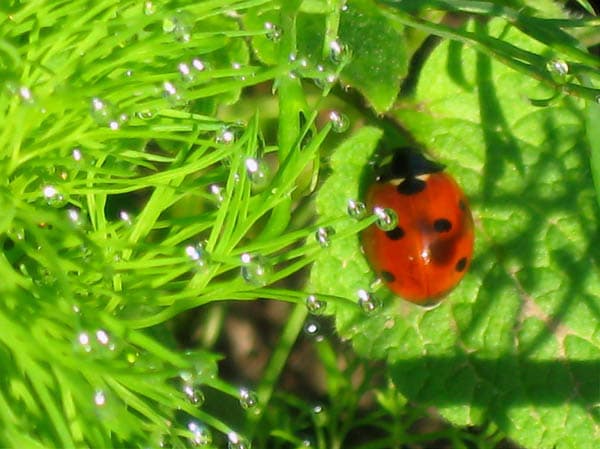
Useful tip. Ladybugs are wonderful allies in the fight against pests. To attract them to the greenhouse, plant dill next to the cucumbers. Ladybugs really like its smell during flowering.